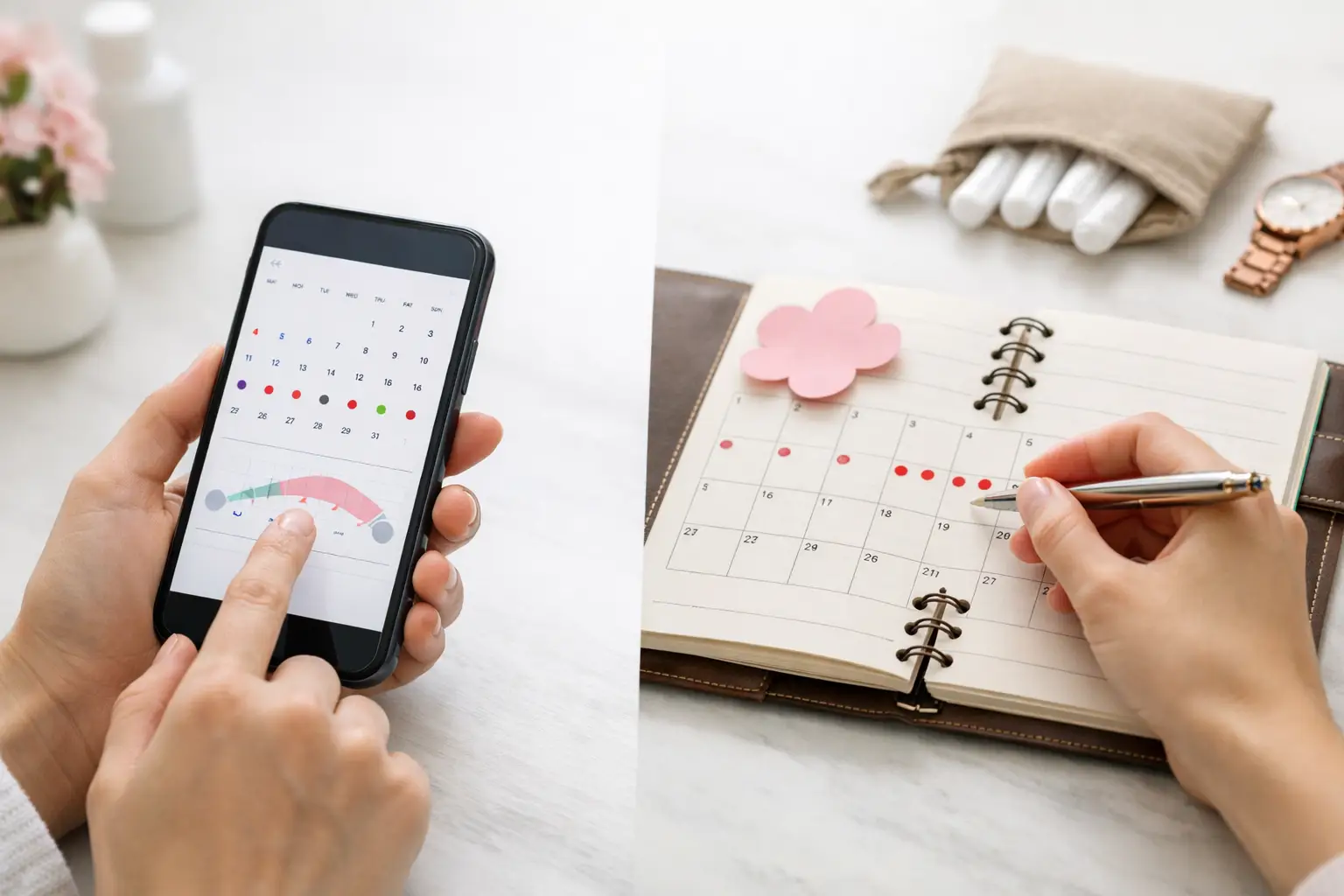
A clinician asks when your last period began, whether the pain arrived before or during bleeding, and what happened after you started a medicine. Suddenly, "roughly a few weeks ago" does not feel like enough. The period tracker versus paper diary question is not really about choosing the more modern option. It is about having a dated record that can speak clearly when memory is under pressure.
That is not fussing. Menstrual symptoms can be difficult to describe retrospectively, particularly when they vary month to month. A record does not make you responsible for solving what is happening in your body. It gives you something concrete to bring to the conversation.
The real comparison: what will you use and trust?
The best method is the one you can return to without it becoming another demand on your attention. A paper diary may feel private, familiar and reassuringly simple. A period tracker may make dates, patterns and related information easier to see together. Neither format is morally better, and neither needs to contain every sensation or thought you have had.
What matters is whether your record answers useful questions: when bleeding started and stopped, how heavy it was for you, whether pain affected daily life, and whether symptoms changed alongside a medication, supplement or treatment. NICE guidance on heavy menstrual bleeding stresses the value of a detailed history, including the nature of bleeding and related symptoms. Specific dates and examples can make that history easier to give.
A useful record exists to be handed to your care team. It was never meant to be kept as evidence against yourself.
What a paper diary does well
A diary has almost no learning curve. You can write "bleeding began, used more pads than usual, cramps stopped me working" in your own words and move on. It does not require a password, a charged mobile phone or confidence with an app. For someone who finds screens exhausting, or who wants their menstrual information kept physically in their possession, that simplicity can be a genuine advantage.
Paper also leaves room for context. You might note an exam week, a long flight, a new prescription or a stressful family event without being forced into preset categories. That can be helpful when you are preparing for an appointment and trying to recall what was different about a particular month.
The limitation is practical rather than personal. Diaries can be misplaced, dates may be hard to scan across several months, and a busy appointment does not always allow time to read pages of notes. If you keep a diary, consider giving each cycle a small, repeatable structure: first day of bleeding, last day, flow, pain, other symptoms and any relevant change in medicines or contraception. You can always add more detail when it feels useful.
What a period tracker can do differently
A period tracker can reduce the remembering work. When you enter a date or symptom as it happens, the record can organise entries over time and make recurring patterns easier to notice. This can be particularly helpful if your question concerns cycle length, spotting, symptoms around ovulation, side effects, or changes following a new medicine.
But a prediction is not a promise. Apps estimate future period dates from past entries, and cycles do not always behave predictably. Stress, illness, travel, changes in weight, hormonal contraception, pregnancy and many other factors can alter bleeding or timing. The NHS notes that periods can vary and advises speaking with a GP if there is a change in your normal pattern that concerns you. A tracker can describe what you recorded. It cannot explain the reason for a change.
Privacy deserves real attention too. Before using any health app, read what information it collects, where it is held, whether it is shared, and how you can delete it. Do not assume that an app is private simply because it concerns private information. A paper diary has its own risks if it is accessible to other people in your household, while a mobile phone can be seen by someone who knows your passcode. Choose the protection that is realistic in your circumstances.
For those using Feminal with a linked clinician, cycle, symptoms, medications, supplements, vitals and health profile information can be recorded in the patient app and viewed live by that clinician. The point is not to generate more data. It is to reduce the burden of reconstructing a whole month in a short consultation.
Period tracker versus paper diary: choose by purpose
If you want a quick personal record and value handwriting, a diary may be enough. If you are trying to see dates and symptoms over several cycles, want reminders to make an entry, or are preparing to discuss a pattern with a clinician, a tracker may be more practical. Many people use both: an app for recurring information and paper for context they want to phrase freely.
There is also a third option worth naming plainly, since it is probably the most common of all: typing notes into your phone's ordinary notes app, with no dedicated tracker involved. It carries none of a proper tracker's pattern-spotting or reminder features, but it also is not sitting on a health company's servers, and for some people that trade-off is exactly right. There is no wrong answer among the three, only the one you will actually keep using.
There is also a middle ground within any of them. You do not have to record every variable from the first day. Start with a floor you can keep: the first day of bleeding, the final day, and one brief note if pain, flow or another symptom was noticeably different. If you are taking medicines or supplements, add their names and any change in timing or dose. This is often more useful than an ambitious system abandoned after four days.
If you are undergoing fertility treatment, follow the protocol set by your care team. Keep your clinic informed through the route it has given you rather than relying on a general cycle prediction. The HFEA advises patients to ask their clinic questions about treatment and medicines, because individual plans differ.
Record the details that make an appointment easier
Clinicians do not need a perfect diary. They need enough information to understand the pattern and its effect on your life. Alongside dates, it can help to note whether bleeding was lighter, heavier or otherwise different from usual; whether pain required pain relief or time off; whether you had bleeding between periods or after sex; and whether fatigue, bowel symptoms, headaches, mood changes or other symptoms appeared at a similar point in the cycle.
Use words that are true rather than words that sound medically impressive. "Changed a pad every hour for three hours" is clearer than "heavy". "Pain woke me at night twice" gives more context than "bad cramps". You are not expected to measure blood loss precisely, and you are not failing if you forget details. The value is in a pattern built over time, not in a flawless log.
Attention has limits. Recording what happened can be grounding. Repeatedly searching every symptom, testing for pregnancy earlier than recommended, or comparing your cycle with strangers online often gives anxiety more material without giving you better information. Aim attention at a question you may need to answer, then step away.
When a record should lead to care
Tracking is not a reason to wait with symptoms that need prompt assessment. Seek urgent medical care for severe or worsening pelvic pain, very heavy bleeding, fainting or feeling extremely unwell. If pregnancy is possible and you have pain or bleeding, seek medical advice promptly. The NHS advises urgent assessment for symptoms that could indicate ectopic pregnancy, including one-sided lower abdominal pain, vaginal bleeding, shoulder-tip pain, dizziness or fainting.
For changes that are not urgent but persist or concern you, book an appointment with your GP, gynaecology service or relevant clinician. Bring the record you have, even if it is incomplete. A few clear dates can be more useful than months of trying to remember alone.
Your body does not become more credible because it is entered into an app, and a paper page is not less valid because it is handwritten. Choose the method that lets you notice what matters, say it plainly, and arrive at care with something more solid than an apology.
Sources used
NICE guidance on heavy menstrual bleeding. NHS guidance on periods and when to see a GP about a change in your normal pattern. HFEA information for people having fertility treatment.