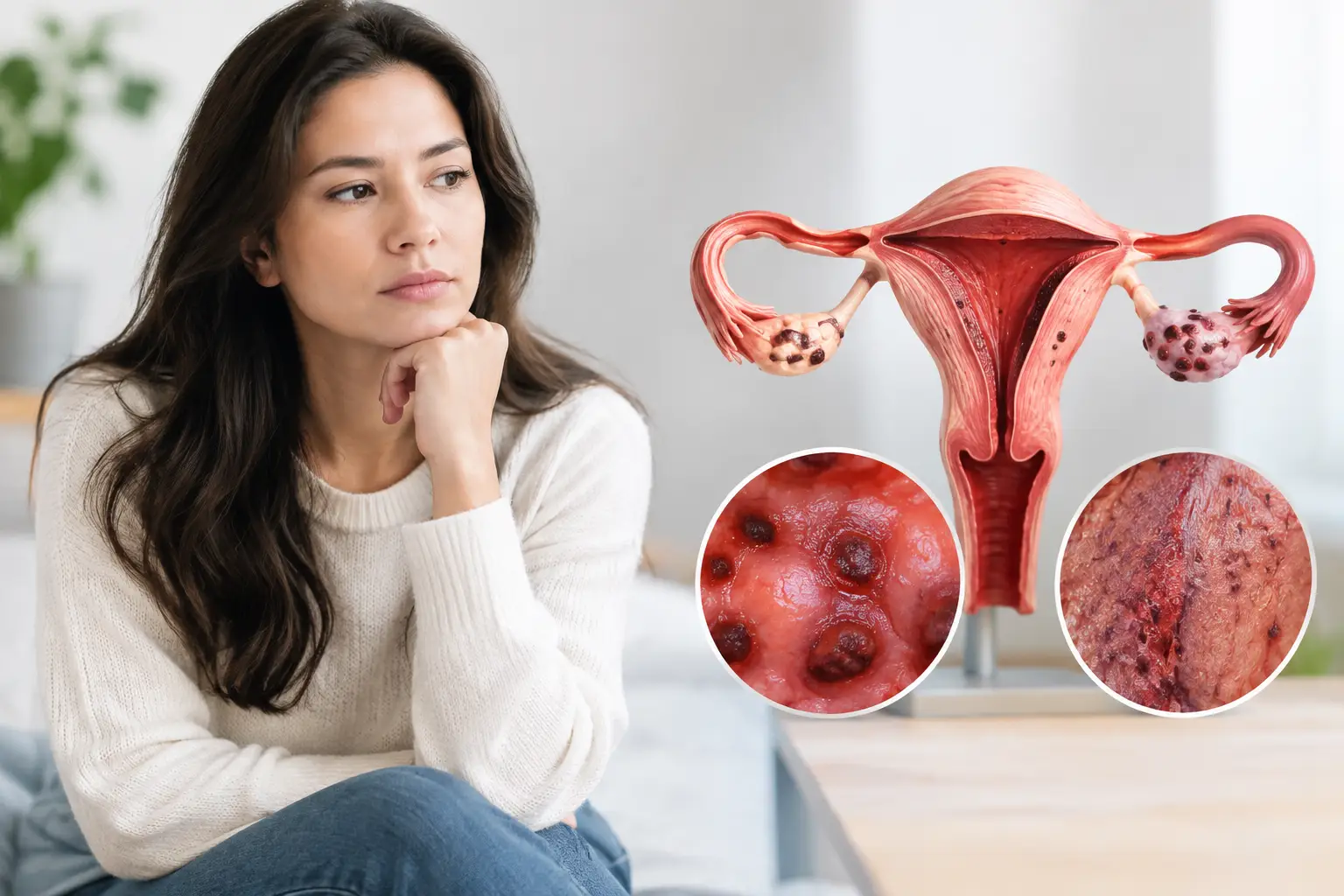
Painful, heavy or changing periods can make endometriosis versus adenomyosis feel like a question with one urgent answer: which one is causing this? The honest answer is that their symptoms can overlap considerably, and some people have both. You are not being dramatic for noticing patterns, asking questions or wanting a clearer explanation than "bad periods".
The useful distinction is where the tissue is found. That difference affects which symptoms may stand out, which tests may help, and why a normal scan does not always settle the question.
Endometriosis versus adenomyosis: the core difference
Endometriosis is a condition where tissue similar to the lining of the womb is found elsewhere in the body, most commonly in the pelvis. It may be on or around the ovaries, fallopian tubes, bowel, bladder or pelvic lining. This tissue responds to hormonal changes and can contribute to inflammation, scarring and pain.
Adenomyosis involves tissue similar to the womb lining growing into the muscular wall of the womb itself. The womb may become enlarged or tender, although this is not always the case. Because the tissue is within the womb muscle, adenomyosis is often associated with heavy, prolonged or particularly painful bleeding.
Neither condition is a personal failure, caused by poor hygiene, or proof that you have done something wrong. Both are genuine gynaecological conditions, and both can take time to assess because bodies do not always present in textbook form.
Symptoms overlap, but patterns can offer clues
Period pain, pelvic pain, pain during or after sex, fatigue and difficulty conceiving can occur with endometriosis. Bowel or bladder symptoms that follow a cycle pattern may also occur, such as pain when opening the bowels during a period, constipation, diarrhoea or pain when passing urine.
With adenomyosis, the more prominent pattern is often heavy menstrual bleeding, severe cramping, pelvic pressure or a sensation of fullness. Periods may last longer, and bleeding can lead to tiredness or iron-deficiency anaemia. Pain can begin before bleeding starts and continue beyond it.
These are tendencies, not rules. Some people with adenomyosis do not have heavy periods. Some people with endometriosis have heavy bleeding. Symptoms also do not reliably show how extensive either condition is. Someone can have severe pain with disease that is difficult to see on imaging, while another person may have few symptoms.
The possibility of both conditions matters. If one explanation does not fully account for what you are experiencing, that does not make your account inconsistent. It may mean your clinician needs to consider a broader Differential Assessment.
How assessment usually works
A clinician will usually begin with your symptoms, period history, medical history and an examination if you are comfortable with one and it is appropriate. A dated account is often more useful than trying to reconstruct months of symptoms in a short appointment.
Ultrasound, particularly transvaginal ultrasound where suitable, can identify signs of adenomyosis and may identify ovarian endometriosis or deep endometriosis. It cannot rule out endometriosis in every case. NICE states that endometriosis should not be excluded where ultrasound or MRI is normal, particularly if symptoms are suggestive.
MRI may be used in some circumstances, often when deep endometriosis or adenomyosis is being considered. Laparoscopy, an operation using a small camera, may be offered when it would help clarify or treat suspected endometriosis. It is not routinely needed for adenomyosis, which is often assessed through symptoms and imaging. Your clinician can explain what a test can answer, what it cannot, and whether the result would change the next step.
A diagnosis is not always immediate. That uncertainty is difficult, especially if pain or bleeding is affecting work, study, relationships or plans for pregnancy. But uncertainty should still come with a plan: what is being considered, what should be recorded, what happens next and when to return.
What can actually be done about it
Treatment for both conditions usually starts with the same first steps: pain relief, and hormonal options such as the combined pill, the progestogen-only pill, or an intrauterine system (the Mirena coil), which can reduce bleeding and pain for either condition. Tranexamic acid can help with heavy bleeding specifically, and is often tried for adenomyosis. For endometriosis, NICE's guidance also covers GnRH analogues, usually considered when other hormonal options have not helped, and surgery to remove or treat visible patches of endometriosis, which can ease pain and, for some people, improve the chances of conceiving, although the disease can return afterwards.
This is where the two conditions part ways in one important respect. Hysterectomy, removing the womb, is a genuinely curative option for adenomyosis when other treatments have not helped and childbearing is complete, because the affected tissue sits inside the muscle of the womb itself. Remove the womb, and the adenomyosis goes with it. Endometriosis does not work the same way. Its tissue lies outside the womb, on the ovaries, bowel, bladder or pelvic lining, so removing the womb does not remove the disease. Hysterectomy is sometimes considered for severe endometriosis that has not responded to other treatment, and it can still help, particularly if combined with surgical removal of visible disease and, in some cases, the ovaries, but it is not the same guaranteed endpoint that it can be for adenomyosis, and symptoms can persist or return.
Hysterectomy ends fertility, so for either condition it tends to be discussed once other options have been tried and childbearing is complete, not as a first step. Your gynaecologist can talk through where you are on that path, and what each option would mean for your specific symptoms and plans.
What to record before an appointment
You do not need to produce perfect data to deserve care. A simple floor is enough: note the first day of bleeding, how heavy it is, the location and severity of pain, and whether pain affects sleep, work or ordinary activities. Include any pain during sex, bowel movements or urination, especially if it changes around your period.
If you have capacity for more detail, record medication taken and whether it helped, bleeding between periods, fatigue, nausea, bloating, dizziness and days you needed to cancel plans. It can also help to note whether symptoms are predictable or occur throughout the month.
This is not surveillance of yourself. It is communication. A record gives your clinician a clearer picture of timing and impact, rather than asking you to remember every difficult day while sitting in a consultation room. Feminal allows patients to record cycles, symptoms, medications and vitals, so that information can be viewed by their linked clinician between appointments.
Attention has limits, though. Repeated symptom searching, comparing your cycle with strangers online or checking for certainty every day can make anxiety louder without making the clinical picture clearer. Record what is useful, then let the record carry some of the remembering.
Fertility questions deserve a direct conversation
Endometriosis can affect fertility for some people, although many people with endometriosis conceive without fertility treatment. Adenomyosis may also be associated with fertility and pregnancy complications, but the individual picture varies with age, symptoms, other fertility factors and the severity or location of disease.
If you are trying to conceive now, planning to soon, or having fertility treatment, say so early in the consultation. It may influence which investigations or symptom-management options are appropriate. It also helps to be specific about your timeline and priorities. Managing pain and heavy bleeding matters in its own right, whether or not pregnancy is part of your plans.
No article can predict fertility for an individual. Your GP, gynaecologist or fertility team can put these conditions into the context of your own history and investigations.
When to seek urgent help
Seek urgent medical care for sudden severe pelvic or abdominal pain, very heavy bleeding that is difficult to manage, fainting, severe dizziness, shoulder-tip pain with abdominal pain, fever with pelvic pain, or a positive pregnancy test with pain or bleeding. These symptoms can have several causes, including conditions that need immediate assessment.
For ongoing heavy periods, worsening pain, pain that stops you doing normal activities, bleeding between periods, pain during sex, or bowel and bladder symptoms linked to your cycle, make an appointment with a GP or gynaecology service. You do not need to wait until symptoms become unbearable to ask for help.
NICE guidance on endometriosis recommends listening to symptom patterns and considering referral when symptoms persist, recur or affect daily life. NHS information on adenomyosis similarly advises seeking medical advice for heavy or painful periods. These are reasonable standards to expect from care.
Your body does not need to present a perfectly tidy case to be taken seriously. Bring the details you have, name the ways symptoms affect your life, and ask what will happen if the first assessment does not provide an answer.