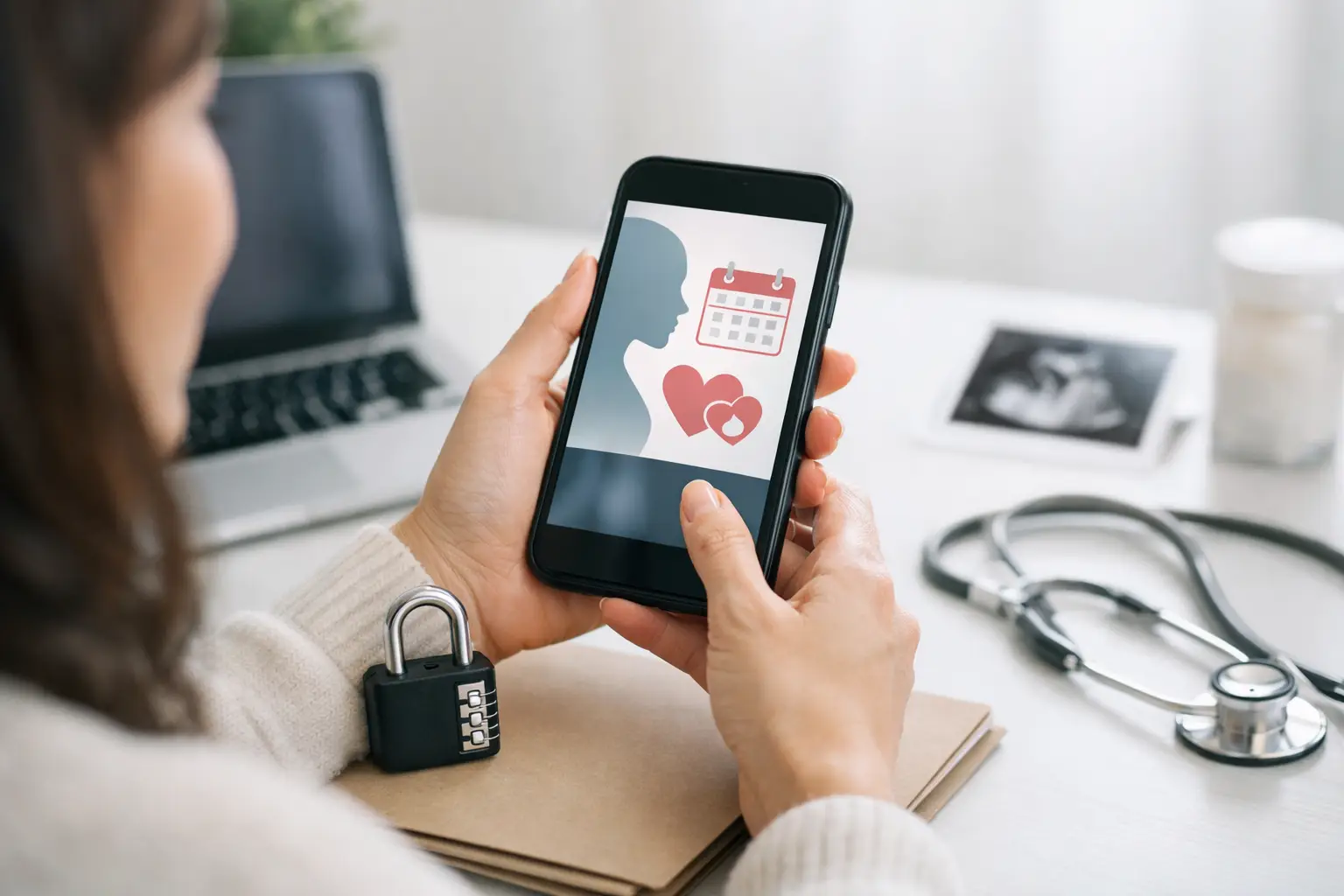
A record of bleeding that changed after a new medication, pelvic pain that appears on day 16, or the date of a fertility appointment can be clinically useful. It is also personal. To protect reproductive health data well, you do not need to stop paying attention to your body. You need to decide what is useful to record, who genuinely needs to see it, and what a service does with it once you have shared it.
That distinction matters because privacy advice can accidentally repeat an old message: do not be too interested in your own body. You are not dramatic for keeping dates and symptoms. A dated, specific record can help you explain what has changed and be taken seriously in a consultation. Privacy is not about making yourself less knowable. It is about keeping control over where that knowledge goes.
What counts as reproductive health data?
It is broader than a period-tracking calendar. Reproductive health data can include cycle dates, bleeding patterns, symptoms, pregnancy and fertility information, contraception, test results, medications, sexual health information, vital signs, appointment notes and messages with a clinician. Information that seems ordinary on its own can become sensitive when combined. A cycle date beside a location history, for example, may reveal more than either item does alone.
Some data is entered deliberately. Other information is created around it: device identifiers, IP addresses, usage patterns, advertising profiles, payment details and records of who has accessed an account. The first question is not simply, "Is this app private?" It is, "What information is collected, why is it collected, and who can receive it?"
Privacy notices can be long, but this is worth reading before you add detailed health information. Look for plain answers on storage, encryption, account deletion, data sharing, research use, advertising, and whether data may be transferred to another country. If the answers are vague, or difficult to locate, treat that as information in itself.
Protect reproductive health data without stopping your record
The right level of detail depends on what you are trying to communicate. A simple floor might be your period start date, cycle changes, significant symptoms and relevant medication changes. That can be enough for many routine conversations. If you are preparing for a gynaecology or fertility appointment, recording timing, severity, duration and what made a symptom better or worse may give your clinician a clearer picture.
Thoroughness is allowed. It can be particularly useful when symptoms are intermittent or when a treatment team has asked for specific observations. But your record does not need to be perfect to be worthwhile. Missing a day does not make the rest unreliable, and you do not have to turn every sensation into data.
Aim your attention at information that has a likely purpose. Recording that pain woke you at 03:00 and stopped you working is often more useful than repeatedly searching what the pain might mean. If a result is due, testing earlier than advised rarely creates clarity. Comparing your cycle with strangers online tends to create noise, not context. Attention should support a decision or a conversation, rather than consume you.
Check the account, not only the app
A well-protected account is part of protecting the health information inside it. Use a long, unique password, ideally held in a reputable password manager, and turn on two-factor authentication where it is offered. Do not share account passwords with a partner, friend or family member, even where trust is not in question. Shared access can become complicated during relationship changes, and it is easier to give someone a specific update than permanent access to your full history.
Keep your phone and tablet updated, use a screen lock, and think carefully before enabling notification previews on a locked screen. A reminder that names a medication, fertility clinic or appointment may be visible to anyone nearby. This is not about secrecy or shame. It is a practical choice about who gets to see your information in ordinary moments.
If you use a shared device, log out after use and avoid saving passwords in a browser profile that others can open. Review connected devices and active sessions in your account settings from time to time. If a phone is lost or you are concerned someone has had access without your permission, change your password from a secure device and use the service's options to sign out elsewhere.
Be deliberate about sharing with care teams
Clinical records and consumer apps do not operate under the same arrangements. A clinician may have legal and professional duties around confidentiality, record keeping and access, while a separate app may have different terms. Do not assume that a health-looking interface is part of your NHS, private clinic or hospital record unless it clearly says so.
Before sharing data with a clinician, ask what they need, how it will be received, whether it becomes part of your medical record, and who in the practice can access it. A concise symptom timeline can be more helpful than forwarding months of screenshots. If you want something documented, say so plainly. If there is information you would prefer to discuss before it is entered into a record, you can ask about the options and limits of confidentiality.
There are limits to privacy in healthcare, including circumstances where a clinician must act to prevent serious harm or meet legal duties. Your care team should be able to explain their local policy. The NHS sets out that health information is generally confidential and should be shared only when justified, while recognising specific legal and safeguarding exceptions.
For fertility treatment, retain copies of key instructions from your care team and use the contact route they provide if something is unclear. The HFEA advises that clinics should provide clear information and appropriate counselling support around treatment. Your questions about where sensitive information is held, and who can see it, are reasonable questions for a clinic.
Questions to ask before you download or connect
You do not need to become a data-protection specialist. Four questions will usually reveal whether a service deserves your confidence:
- What health information and technical information does it collect?
- Is information used for advertising, sold, or shared with analytics or commercial partners?
- Can you download or delete your data, and what is retained after deletion?
- Can you control what is shared with a linked clinician, partner, wearable or other service?
A good answer is specific. "We take privacy seriously" is a sentiment, not a policy. Look for explanations of actual practices, including whether optional features are truly optional. Be wary of services that require broad permissions which do not match their purpose, such as continuous location access for a basic cycle calendar.
Applied to Feminal, the honest answers are these: no advertising, and your data is never sold, in any form. Your conversations with Alina are not used to train AI models; her purpose is to inform you, not to learn from you. Your account and what is stored with it can be deleted. And what a linked clinician sees is exactly what you have chosen to record, controlled through pairing rather than assumed by default. For the one part of the app built to hold nothing at all, the Private Journal saves nothing by design, which makes it the right place for reflection you never want entered into a record.
Connection features deserve a separate check. Linking a wearable, calendar, email account or social login may be convenient, but it can widen the amount of information available to a service. Convenience is a legitimate benefit. The trade-off is that more connections create more places where an account setting, breach or change in policy could affect you. Connect only what improves the information you need.
Know the difference between private reflection and a health record
Not every thought needs to become part of a permanent account. It can help to separate information intended for clinical discussion from private reflection. If you write about a difficult relationship, fear, grief or uncertainty, decide whether you want it saved, shared, or simply expressed in the moment. The point is not to document more. It is to make each kind of attention answerable to you.
When privacy concerns should not delay care
Protecting data should never mean ignoring symptoms that need prompt assessment. Seek urgent medical care if you have severe or worsening abdominal or pelvic pain, very heavy bleeding, fainting, chest pain, difficulty breathing, or symptoms that concern you during pregnancy. NHS guidance also advises urgent assessment for possible ectopic pregnancy symptoms, such as one-sided lower abdominal pain with vaginal bleeding or shoulder-tip pain.
If you are worried that someone is monitoring your devices or accounts, use a safe device where possible and seek support from a trusted healthcare professional or specialist domestic abuse service. Do not make changes that could increase your immediate risk. Your safety comes before tidying up a digital record.
Your health data belongs in the service of your care, not in a system that asks you to surrender privacy for the right to pay attention. Keep the record that helps you speak clearly. Ask where it goes. Change your mind when a service no longer earns your trust.
Sources used
NHS guidance on health information confidentiality and safeguarding exceptions. HFEA information on clinic communication and counselling support in fertility treatment.