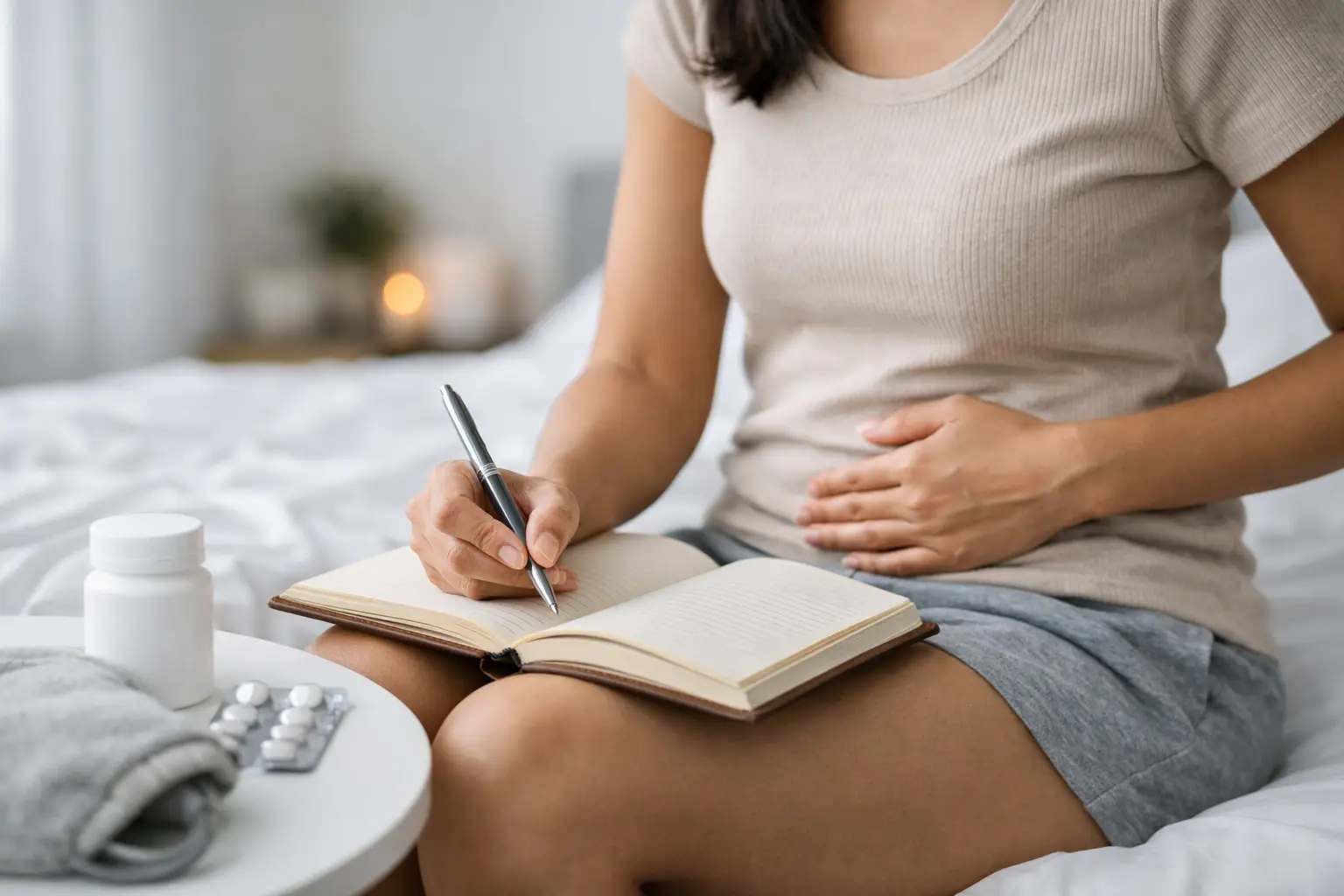
Pelvic pain can be difficult to explain after the fact. A pain diary gives the appointment a timeline: not simply that you hurt, but when it began, where it was, what was happening in your cycle and how it affected ordinary life. This guide to a pelvic pain diary is not an instruction to watch yourself anxiously. It is a way to make your observations easier to communicate, especially when pain is intermittent, changes from month to month or has been dismissed as something you should simply endure.
You are not dramatic for noticing pain. You are also not failing if you record only a few days, or forget to write anything during a difficult week. A dated, specific record can support a more useful conversation with a clinician, but it is not a test of how well you are coping.
Why keep a pelvic pain diary?
Pelvic pain means pain in the lower abdomen or pelvis. It can occur around periods, ovulation, sex, bowel movements or urination, or at times that seem unrelated to your cycle. The possible reasons are wide-ranging. Conditions affecting the reproductive organs, bladder or bowel can all be relevant, as can musculoskeletal pain. A diary cannot tell you what the cause is. It can, however, show patterns that a single description such as "bad period pain" may conceal.
NICE specifically advises clinicians to consider a pain and symptom diary when assessing suspected endometriosis, and its guideline on the condition (NG73) is one of the sources behind this approach. That is not because every pain pattern points to endometriosis, and a diary is not a way to diagnose it yourself. It is because timing, associated symptoms and the impact on daily activities can help structure a clinical assessment, whatever the eventual explanation turns out to be. The same principle is useful more broadly: a record turns memory into information that can be discussed.
The aim is communication with your care team, not a diary you keep to prove your suffering is real. Attention should be aimed at details that may be useful, then put down. Repeatedly searching symptoms online, testing early without clinical advice, or comparing your cycle with strangers' accounts rarely gives the same return.
A guide to pelvic pain diary entries
Begin with a simple floor that you can sustain. On any day you have pain, note the date, where the pain is and how strong it feels. Add whether you are bleeding or where you think you are in your cycle, if you know. This alone may be enough to make a future appointment more precise.
If you have capacity for more detail, record the following:
- The pain itself: use your own words, such as cramping, stabbing, burning, pressure, pulling or a dull ache. Say whether it is central, on one side, in the lower back, around the vagina or rectum, or spreads elsewhere.
- Timing and duration: note the time it started, how long it lasted and whether it was constant or came in waves. Include the first day of full menstrual bleeding, spotting, or any unexpected bleeding.
- Severity and impact: a 0 to 10 scale can be helpful, but pair it with what the number meant. For example, "7/10, left work early and could not stand upright for 20 minutes" is more informative than a number alone.
- Related symptoms: record nausea, bloating, constipation, diarrhoea, pain when opening your bowels, pain when passing urine, unusual discharge, fatigue, dizziness or pain during or after sex, when present.
- What was happening around it: note exercise, sleep disruption, illness, stress, travel or a bowel movement only if it appears relevant. You do not need to account for every meal or mood.
Include medications and supplements you took, with the dose and time where possible, and whether they appeared to change the pain. Do not alter prescribed medication based on diary patterns without discussing it with the clinician who prescribed it.
Here is the level of detail that often helps: "14 May, cycle day 2. Cramping low on the right from 06:30 to 10:00, 6/10. Heavy bleeding with small clots. Nauseous, stayed in bed until 09:00. Took prescribed pain relief at 07:00, pain eased to 3/10 by 10:00." It is factual, not over-written, and it separates what you felt from what you did.
Keep context without turning the diary into a project
A pain score is personal. One person's 5 is not another person's 5, so consistency matters more than choosing the perfect number. If numbers feel artificial, use labels such as mild, moderate and severe, alongside the effect on your day.
Likewise, a diary does not need to become an exhaustive account of your body. You may choose to record pain only, or pain plus bleeding and bowel or bladder symptoms. If sex is relevant to your pain, you can record that plainly, but you do not owe anyone details you do not want to write down. What matters is that the record is useful to you and sufficiently clear for a clinician to ask better questions.
If a pattern emerges, describe it rather than interpret it. Write, "pain began two days before bleeding in three consecutive cycles", rather than deciding what it must mean. A clinician can place that pattern alongside your medical history, examination and any appropriate tests. Your record is evidence of your experience, not a diagnosis.
If investigations come back clear, the pain doesn't
It is worth saying plainly: a normal scan does not mean your pain is not real, and it does not mean your diary was pointless. Long-term pelvic pain, sometimes lasting six months or more, is recognised in its own right by bodies including RCOG, and it does not always have a single structural cause that a single test can find. If that is where you end up, the diary has not failed. It becomes, if anything, more useful, since a documented pattern over months is exactly what supports ongoing management and further discussion when the first round of investigations has not provided an answer.
Bring the pattern to your appointment
Before an appointment, look back for three things: when the pain occurs, what tends to occur with it, and how it affects your life. You might say, "The pain is usually worst on days one and two of bleeding", or, "I have recorded pain with bowel movements most weeks, including outside my period." These are concrete starting points for discussion.
It can also help to name your main concern directly. Perhaps you are worried because the pain is worsening, because it causes you to miss work or study, because it affects sex, or because you are trying to conceive. Pain that interrupts your life deserves to be discussed even if you have learned to function through it.
If you use Feminal, the symptom tracker in your Health Dashboard is built for exactly this: log pain alongside your cycle, medications, supplements and vitals, dated as it happens. Where you are linked with a clinician, those entries can be viewed live in the clinician portal between appointments. The record supports the conversation, but it does not replace clinical assessment.
When not to wait for a diary
A diary is for patterns, not for delaying care. Seek urgent medical help if pelvic pain is severe, sudden, rapidly worsening, or comes with fainting, dizziness, shoulder-tip pain, fever, persistent vomiting, heavy vaginal bleeding, or difficulty breathing. Get urgent advice too if you may be pregnant and have pain or bleeding, as these can be signs of an ectopic pregnancy. The NHS advises urgent assessment for severe pelvic pain and for symptoms that may indicate ectopic pregnancy.
For ongoing or recurrent pelvic pain, arrange a routine appointment with your GP, gynaecologist or relevant clinician. The NHS advises seeking medical advice when pelvic pain does not go away, keeps coming back, or affects daily life. You do not need to wait until you have several flawless months of records to ask for help.
The most useful entry is often not the most detailed one. It is the one that lets you say, with confidence, "This is what has been happening to my body." That is a reasonable thing to know, record and bring into care.
Sources used
NICE guideline NG73, Endometriosis: diagnosis and management; NHS, Pelvic pain in women; NHS, Ectopic pregnancy; RCOG patient information on long-term pelvic pain.