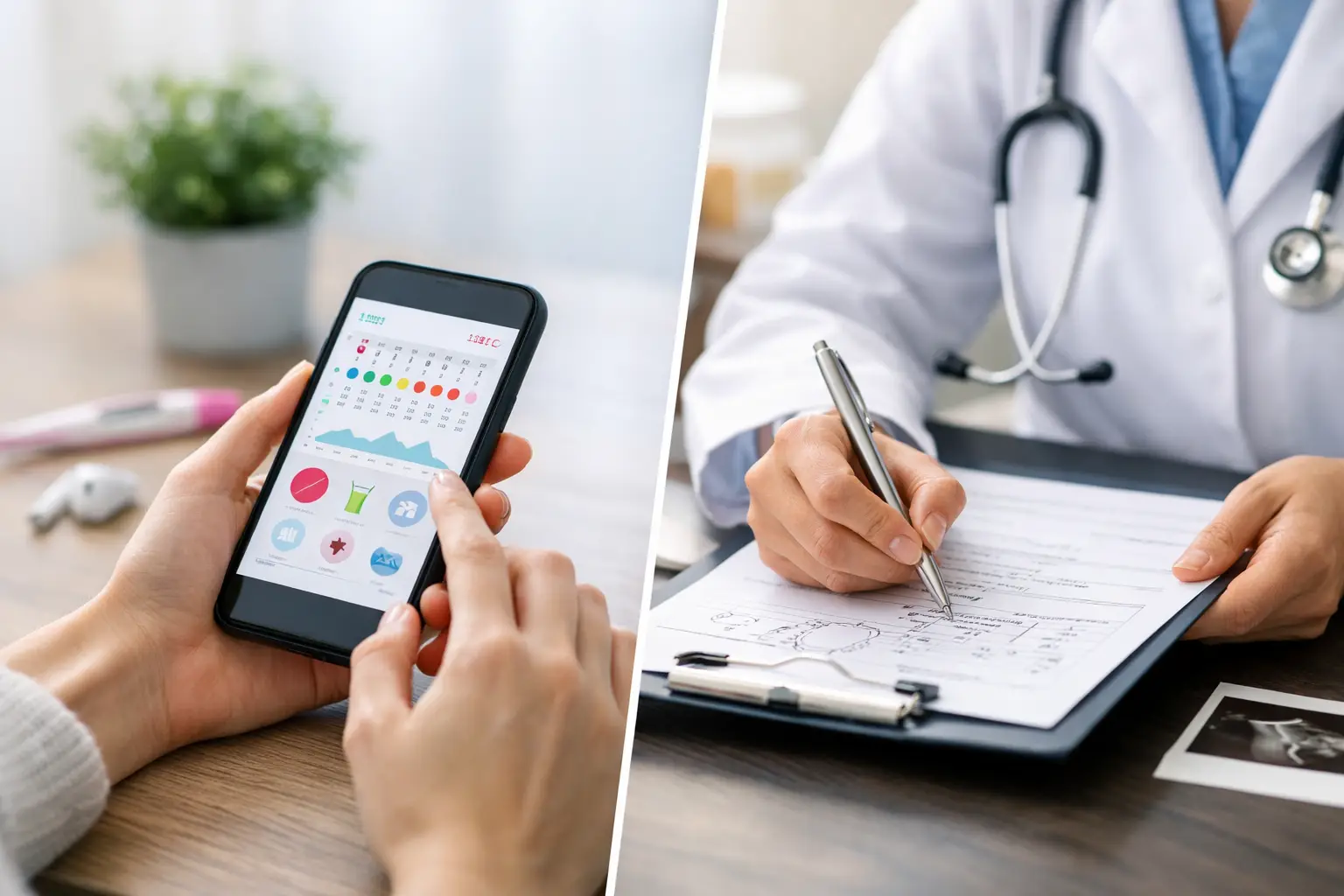
A fertility app versus clinic notes is not really a contest between technology and medicine. It is a question of what happens to the details that exist between appointments: the bleeding that began on a Tuesday, the medication dose that changed, the pelvic pain that interrupted sleep, or the question you forgot once you were in the room. None of those details is trivial. Noticing your body is not fussing, and a dated record can help make sure the account of your health does not depend on memory under pressure.
Fertility app versus clinic notes: different jobs
Clinic notes are the formal account of care. They usually record the reason for the appointment, relevant history, examination findings, test results, discussions, and the plan agreed with the clinician. They are essential for continuity and for clinical accountability. A fertility clinic also has its own treatment records, which should remain the source of truth for prescribed treatment and decisions.
But clinic notes are necessarily selective, and they are usually held by the provider who wrote them rather than travelling with you. If your care involves a GP, a fertility clinic and perhaps a second opinion elsewhere, each one typically starts from what you can tell them, not from a shared file. That gap is not anyone's failure. It is simply how separate providers work, and it is exactly the kind of gap a record you hold yourself is built to close.
A ten-minute consultation also cannot always hold the texture of several weeks: when spotting began, whether nausea followed a dose, how often headaches occurred, or whether your usual cycle pattern has shifted.
A personal record has a different job. It preserves the timeline you lived through, in language that makes sense to you, so that you can bring useful specifics to care, and so that history does not reset every time you see someone new. It does not replace a clinician's record, test results or judgement. Nor can an app determine why a cycle is late, whether ovulation occurred, or whether treatment should change. Those questions need proper clinical assessment.
The useful comparison, then, is not which record is better. It is whether the two records can make the conversation more complete.
Why dates and patterns matter in fertility care
Fertility questions often involve timing, but timing is more than identifying a presumed fertile window. Clinicians may need to understand cycle length and variation, the first day of bleeding, symptoms, previous pregnancies, medicines, relevant health conditions and the timing of investigations or treatment. NICE guidance on fertility problems recognises that assessment draws on a detailed history alongside appropriate investigations.
Memory is imperfect, particularly when you are anxious, tired, in pain or balancing treatment with work and family life. "My periods have been strange lately" is a valid starting point. "Bleeding started on 4 May, lasted six days rather than my usual four, and I had new one-sided pain on day three" gives your clinician something more concrete to explore.
That specificity is advocacy, not a demand for certainty. It helps distinguish a one-off variation from a pattern worth discussing. It can also prevent a familiar problem in appointments: spending the first half trying to reconstruct the last three months, then leaving with the question you most needed to ask still unspoken.
The HFEA advises people having fertility treatment to understand their treatment plan and ask questions of their clinic. A clear personal timeline can support those conversations, especially when there are several medicines, scans and appointments involved. Your clinic remains responsible for setting treatment. If you are having IVF, follow the protocol provided by your care team rather than changing anything because an app estimate or a previous cycle suggests something different.
A record that is useful without taking over your life
There is no prize for recording every bodily sensation. There is also no failure in missing a day. The right amount of attention is the amount that helps you communicate and then lets you get on with living.
For most fertility appointments, a simple floor is enough: record the first day of bleeding, approximate cycle length, any significant symptoms, medicines and supplements you take, and questions you want to raise. If you have been asked to monitor something specific, such as blood pressure or medication effects, record that as agreed with your clinician.
More detail can be worthwhile when it answers a real question. For example, repeated mid-cycle bleeding, worsening pain, a new pattern after starting medication, or symptoms that affect daily life are easier to discuss when their timing and severity are clear. You might record what happened, when it started, how long it lasted, what made it better or worse, and whether it stopped you working, sleeping or carrying out usual activities.
Some attention pays very little back. Repeatedly searching symptoms, testing earlier than advised, or comparing your cycle with strangers' online can increase distress without producing clearer information. Cycle variation is common, and apps that predict fertile days use estimates rather than direct knowledge of what is happening in your ovaries. An estimate can be a prompt for a conversation, not proof that anything is wrong or right.
What clinic notes may not show
Formal notes can tell a clinician that you reported pain. They may not convey that you had avoided mentioning it for six months because you thought you were being dramatic. They may list a medication, without showing that you struggled to remember whether nausea began before or after it was started.
This is where a patient-held record can change the quality of a consultation. It gives you permission to arrive with your own evidence. That matters particularly in reproductive health, where women have often been taught to minimise bleeding, pain or worry until it becomes impossible to ignore.
A record can also make room for matters that feel difficult to say aloud. Fertility care can involve grief, uncertainty, relationship pressure and financial strain. Those feelings do not need to sit in a record shared with your clinician to be worth acknowledging. If you want somewhere private for that side of it, Feminal's Journal is a different kind of space entirely: built to hold what you write and keep nothing, which is a different purpose from the dated clinical record described here. You do not need to turn an app into a surveillance project or disclose more than you want. The goal is not a perfectly documented body. It is an account that reflects what you think your clinician needs to know.
Using an app safely alongside your clinic
Before relying on any fertility app, check what it records, who can access the information, whether you can correct entries, and what happens to your data if you stop using it. Be especially cautious about apps that make confident claims from limited information, treat prediction as fact, or encourage you to alter medication or treatment plans without speaking to your care team.
Feminal is designed around a more practical model: a patient can record cycle information, symptoms, medications, supplements, vitals, health profile and a pre-appointment intake form, while a linked clinician can view the relevant record between appointments. It describes, observes and educates. It does not diagnose conditions or replace clinical care.
Whatever tool you use, bring the essentials into the appointment. A short timeline, current medication list and two or three questions are often more useful than handing over months of unfiltered data. Ask your clinician what would be helpful for you to record before the next review. Their answer may be very specific to your symptoms, investigations or treatment.
When an app record should not wait for an appointment
Recording symptoms is not a reason to wait if you feel acutely unwell. Seek urgent medical care for severe or worsening abdominal or pelvic pain, very heavy bleeding, fainting, chest pain, breathing difficulty, or if you are pregnant or might be pregnant and have pain or bleeding. The NHS advises urgent assessment for symptoms that could indicate an ectopic pregnancy, including one-sided lower abdominal pain with bleeding or brown discharge.
For less urgent but persistent concerns, make an appointment rather than trying to interpret a pattern alone. The NHS advises speaking to a GP if you have been trying to conceive for a year without pregnancy, or sooner if you are aged 36 or over or have a known reason to be concerned about fertility.
You do not have to remember every date perfectly to deserve careful care. Start with what you know, write down what changes, and let your clinician help make sense of the parts that need medical interpretation.
Sources used
This article reflects public guidance from the NHS on trying for a baby and ectopic pregnancy, NICE guidance on fertility problems, and HFEA information for people having fertility treatment.