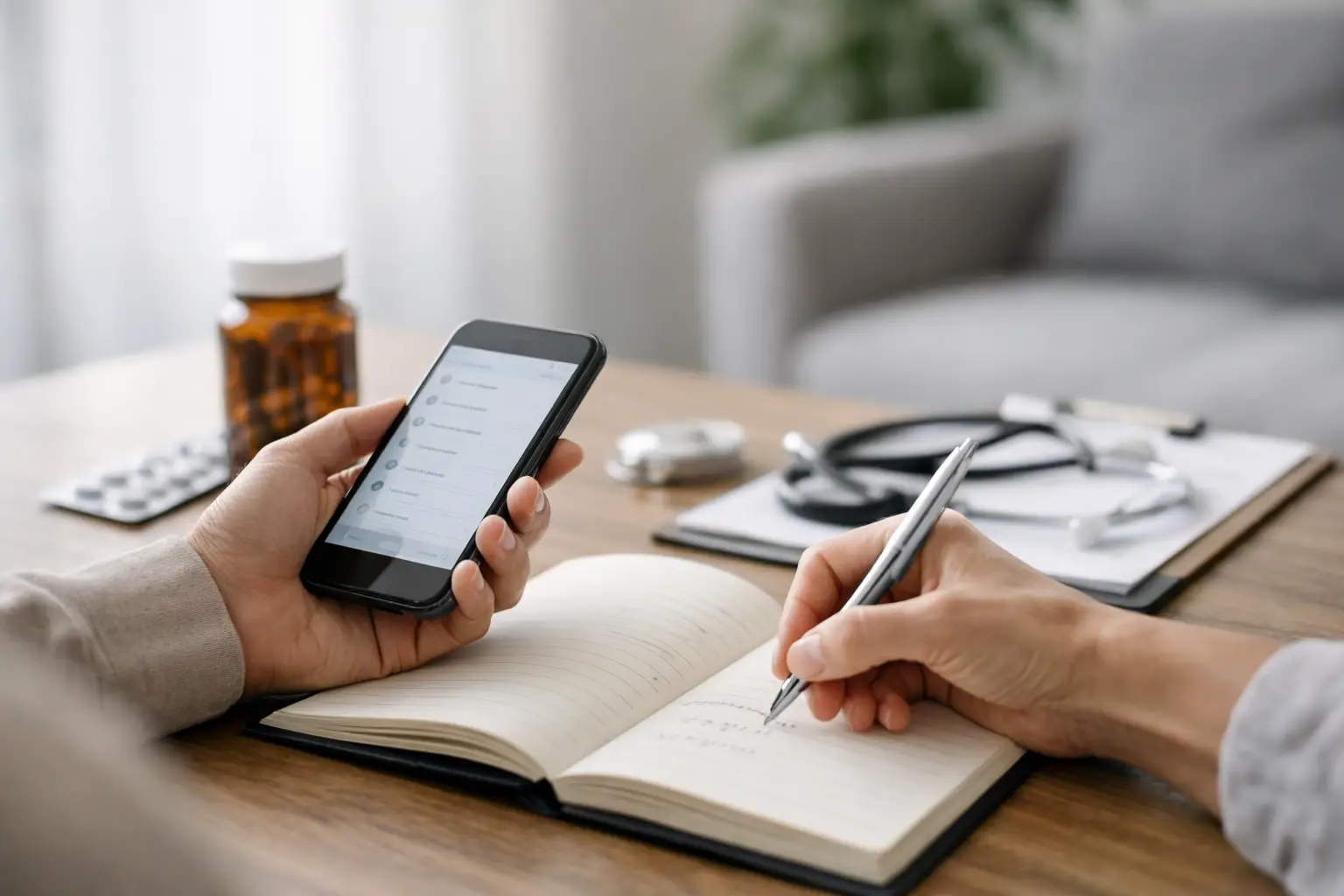
The question is rarely just how to record symptoms for doctor appointments. It is usually: will I remember what mattered, and will anyone take it seriously? A short, dated account can make a difficult conversation more concrete. It is not evidence that you are anxious or over-focused on your body. It is information that may help you and your clinician see what memory smooths over.
You do not need a perfect diary. You need enough detail to show change, timing and impact. If you miss days, start again when you can. A partial record is still a record.
Start with the detail that changes the conversation
A clinician can ask better follow-up questions when a symptom has a beginning, a pattern and a consequence. "My periods have been awful" is a valid place to start. "Bleeding began on 4 May, was heaviest on days two and three, I changed protection every hour for several hours, and I cancelled work because of pain" gives the conversation a clearer shape.
For each symptom, aim to note when it started, where you felt it, what it felt like, how long it lasted and whether it changed your usual activities. Then add anything that seems connected: the day of your cycle, bleeding or discharge, sex, exercise, sleep, a medication change, illness or a stressful week. You are not trying to prove what caused it. You are describing what happened.
Intensity can be useful, but only if it means something to you. A number from zero to ten is one option. Plain language is often just as helpful: mild enough to continue normally, needed pain relief, had to lie down, woke me from sleep, or prevented work, study, caring responsibilities or sex. This is particularly useful with symptoms that fluctuate, such as pelvic pain, headaches, bowel changes, fatigue, breast tenderness, acne, mood changes or irregular bleeding. One consultation may fall on a relatively good day. Your record can show the days around it.
A simple floor, then room for more
If recording feels like another task on an already full list, keep the floor low. At the end of the day, write the date, cycle day if known, the main symptom, how much it affected you, and anything unusual such as bleeding, a new medicine or a raised temperature. That can take under a minute.
When you want or need more detail, add timing, duration, location, intensity, relief measures and relevant context. For example: "Cycle day 19. Sharp pain low on right side from 14:00 to 18:00. Worse when walking. Took ibuprofen at 15:00, some relief. No bleeding. Nausea at 16:00." That is not an attempt to diagnose yourself. It is a useful description.
Some situations benefit from particular details. If bleeding is a concern, note whether it is spotting or flow, how long it lasts, whether there are clots, and how often you need to change pads, tampons, period underwear or a cup. The NHS advises seeking urgent assessment for very heavy bleeding, including needing to change a pad or tampon every hour for more than two hours, especially if you feel unwell, dizzy, short of breath or have chest pain.
For pain, location matters. "Pelvic pain" may be enough for a first note, but right-sided, left-sided, central, deep, burning, cramping or pain during bowel movements can help your clinician understand the experience more precisely. Note what eases or aggravates it, but do not feel obliged to repeatedly test painful activities to gather better data.
For medicines and supplements, record the name, dose, time taken and any noticeable change. Do not alter a prescribed treatment plan based on a symptom record alone. Discuss concerns, side effects or missed doses with the clinician or pharmacist responsible for your care.
Record symptoms for doctor appointments, not as evidence against yourself
The purpose of tracking is communication. It is not to turn every sensation into a project, nor to earn the right to ask for care. Aim your attention where it gives something back: at what is changing, recurring, disrupting your life or relevant to the question you need answered.
There is also attention that rarely pays. Searching each symptom late at night, testing for pregnancy earlier than recommended, repeatedly checking whether one side feels different, or comparing your cycle with strangers' accounts can intensify uncertainty without making the clinical picture clearer. If a thought is spiralling, write the question down for your appointment rather than trying to settle it alone online.
A record is not a tribunal. You do not need photographic proof of bleeding, perfectly timed temperatures or a pain score every hour to be believed. Your account of pain, fatigue, mood or disruption is clinically relevant because it is your lived experience. NICE guidance on heavy menstrual bleeding specifically recognises the impact on quality of life, not only the measured volume of blood loss (NICE guideline NG88).
Turn notes into an appointment-ready account
Before an appointment, read back through the last few weeks or cycles and identify the pattern in two or three sentences. This gives you a useful opening when time is short.
You might say: "For the last three cycles, pain has begun two days before bleeding and is stopping me from working on the first day." Or: "Since starting this medication six weeks ago, I have had spotting most days and headaches twice a week." Add the question you most need answered, whether that is what may be worth investigating, how to manage symptoms while waiting, or when to seek further help.
Bring the record itself if you can, but do not hand over pages without context. Lead with what has changed, how long it has been happening and what impact it is having. If you have a long history, a one-paragraph timeline can help: when symptoms began, any pregnancies or procedures that feel relevant, major changes in your cycle, previous tests, and treatments already tried. Your clinician can decide which details are clinically relevant.
Feminal is designed for this practical gap: you can record cycle information, symptoms, medications, supplements and vitals in one place, with the record visible live to a clinician you have linked, and complete a pre-appointment intake form so your history is set down calmly before you arrive rather than recited from memory in the room. The point is not that an app knows your body better than you do. It is that you should not have to reconstruct weeks of experience from memory in a ten-minute consultation.
When a record should not mean waiting
Recording symptoms is useful when you are safe to observe a pattern. It is not a reason to delay care for symptoms that need immediate assessment. Seek urgent medical help for severe or worsening pelvic or abdominal pain, heavy bleeding with faintness or breathlessness, possible pregnancy with pain or bleeding, chest pain, difficulty breathing, new confusion, weakness on one side, or thoughts of harming yourself.
If you are pregnant or may be pregnant, pain and bleeding should be discussed urgently with an appropriate maternity service, GP, urgent care service or emergency department. RCOG guidance notes that early-pregnancy bleeding and pain are common, but can sometimes indicate a problem needing assessment. Trust the change in your body, particularly if symptoms are severe, one-sided, associated with shoulder-tip pain, dizziness or collapse.
For less urgent but persistent concerns, book a routine appointment rather than waiting until your notes look complete. The NHS advises seeing a GP for periods that are becoming more painful, heavier, irregular, or are affecting daily life. The same principle applies to new symptoms that persist, recur or simply do not feel like your normal.
You are allowed to notice your body before it becomes an emergency. A dated note is not fussing. It is a small act of clarity, and a way to enter the room with more than a vague recollection of a difficult month.
Sources used
NHS guidance on heavy periods and when to seek urgent help; NICE guideline NG88 on heavy menstrual bleeding; RCOG patient information on bleeding and pain in early pregnancy.