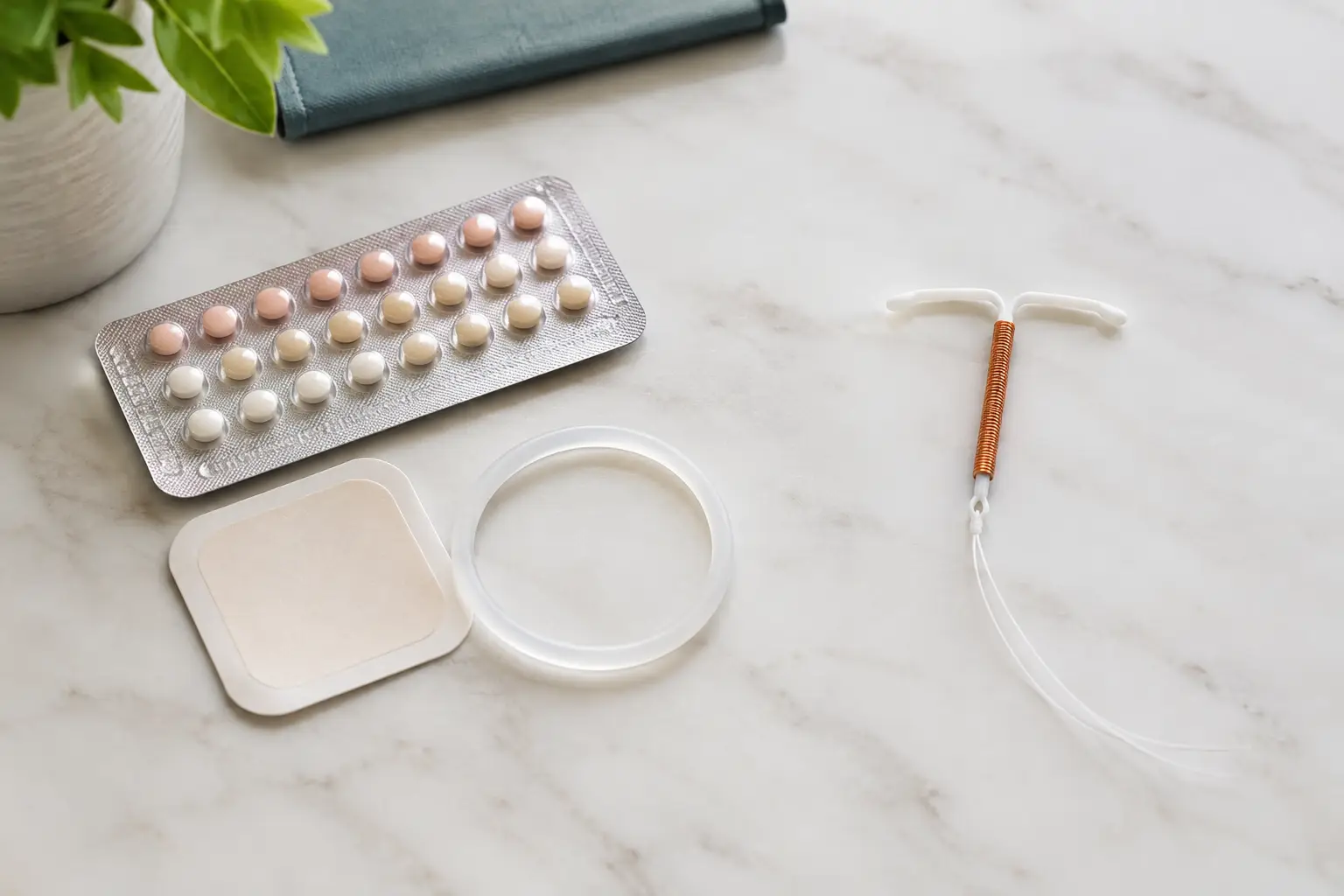
A contraceptive method can be highly effective and still be the wrong fit for your body, your bleeding pattern or your plans. The useful question in hormonal versus copper contraceptives is not which option is universally best. It is which trade-offs you can live with, and which details your clinician needs in order to help you choose safely.
Copper contraception is an intrauterine device, often called a copper coil or copper IUD. Hormonal contraception is a wider category that includes pills, patches, rings, injections, implants and hormonal intrauterine systems, or IUSs. In practice, many people comparing a hormonal and copper option are deciding between an IUS and a copper IUD, because both sit in the uterus, are fitted by a trained clinician and work for years.
Both deserve a conversation without embarrassment. Your periods, migraines, mood, skin, pain and preferences are relevant clinical information, not evidence that you are being difficult.
Hormonal versus copper contraceptives: the central difference
A copper IUD contains no hormones. It releases copper into the uterus, which prevents fertilisation. A hormonal IUS releases a small amount of progestogen into the uterus. Other hormonal methods deliver hormones in different ways and at different doses, which is one reason they should not all be treated as interchangeable.
Both copper IUDs and hormonal IUSs are among the most effective reversible contraceptive methods. They are also low-maintenance once fitted: depending on the device, they can work for several years. Fertility returns promptly after removal for both methods. The NHS states that an IUD can also be used as emergency contraception if fitted within five days of unprotected sex, or within five days of the earliest estimated day of ovulation. A hormonal IUS cannot be used for this purpose.
Neither protects against sexually transmitted infections. Condoms remain important if there is a possibility of exposure.
Bleeding is often the deciding factor
For many people, the most practical difference is what happens to their periods.
A copper IUD can make periods heavier, longer or more painful, especially in the first months after fitting. For someone who already has heavy bleeding, significant period pain or iron-deficiency anaemia, that possibility deserves proper weight. It does not mean a copper IUD is automatically unsuitable, but it may shape the decision.
A hormonal IUS commonly makes bleeding lighter over time. Some people have irregular spotting at first, and some eventually have very light periods or no periods. This is a recognised effect of the method, not blood becoming trapped in the body. Hormonal IUSs may also be offered as part of treatment for heavy menstrual bleeding, although the right option depends on the cause of the bleeding and your individual history. NICE guidance on heavy menstrual bleeding includes the levonorgestrel-releasing IUS among treatment options.
If having a predictable monthly bleed matters to you, say so. If avoiding heavy bleeding matters more, say that too. Neither preference is trivial.
What about hormonal side effects?
Hormonal methods can bring side effects such as headaches, breast tenderness, acne, nausea, mood changes or changes in bleeding. The experience varies considerably by method and by person. A hormonal IUS has lower overall hormone exposure than methods that work throughout the bloodstream, but some people still notice hormonal effects.
Copper IUDs avoid hormone-related effects, which can make them appealing if you have previously felt unwell on hormonal contraception or simply do not want to use hormones. But hormone-free does not mean side-effect-free. The possible effect on bleeding and cramps is the key trade-off.
For combined hormonal contraception, which contains both oestrogen and progestogen, there are additional safety considerations. It may not be appropriate for everyone, including some people who have migraine with aura, a history of blood clots, certain cardiovascular conditions or who smoke at an older age. Your clinician can assess this in context. These considerations do not apply in the same way to copper IUDs or progestogen-only methods.
Fitting, removal and the first few months
Both IUD and IUS fitting can cause discomfort or pain. You are entitled to ask in advance what the appointment involves, what pain relief is available, whether you can bring someone with you, and what will happen if you want the procedure paused or stopped. A previous difficult fitting, pain with pelvic examinations or a history of trauma is relevant information to share if you feel able.
If you have never given birth, it is worth knowing that this is not a reason to be turned away from either option. Fitting can be a little more uncomfortable and the device slightly more likely to be expelled in this group, particularly at a younger age, which is worth discussing with your clinician, but current guidance does not restrict IUDs or IUS devices to people who have already had children. If you have been told otherwise, or have assumed it yourself, it is worth raising directly.
Cramping and light bleeding can occur after fitting. There is a small risk of the device coming out, particularly soon after insertion, and a very small risk of perforation during fitting. Infection risk is slightly higher in the first weeks if an untreated sexually transmitted infection is present at the time of insertion. These risks are uncommon, but they should be explained clearly before consent. The NHS and the Royal College of Obstetricians and Gynaecologists provide patient information on intrauterine contraception and what to expect.
Seek urgent medical care if you develop severe or worsening lower abdominal pain, fever, unusual or foul-smelling discharge, very heavy bleeding, or think you may be pregnant with an IUD or IUS in place. Pregnancy is rare with either method, but an ectopic pregnancy needs prompt assessment.
Questions that make the choice clearer
Rather than beginning with a list of side effects, begin with your non-negotiables. Do you want a method that may reduce bleeding, or would you rather avoid hormones? Would spotting feel manageable, or would it create anxiety? Do you need emergency contraception now? Are you likely to want pregnancy in the next year, or do you want a method you can largely forget about for longer?
Your medical history matters as much as your preference. Mention heavy periods, pelvic pain, anaemia, migraine, previous blood clots, breast cancer, liver disease, recent pregnancy, recurrent infections and any medicines you take. Your clinician may recommend an examination, pregnancy test or infection screening before fitting an intrauterine method.
There is no prize for choosing the method that sounds most natural, most convenient or most popular online. A method that gives you reliable contraception but leaves you exhausted by heavy bleeding is not automatically a success. Equally, a method that suits a friend may cause unwanted effects for you.
Keep a record that helps, not one that consumes you
If you are deciding whether to continue, change or remove a method, a dated record can make the next appointment more useful. A simple floor is enough: note bleeding days, pain, headaches and any symptom that disrupts work, sleep or daily life. Add medications or pain relief if relevant. More detail is welcome if it helps you see a pattern, but you do not need to account for every sensation to deserve care.
Feminal can help you record cycles, symptoms, medications and vitals so that the pattern is available to your linked clinician between appointments. The record exists to speak for you between visits, not to keep watch over you. What tends not to help is repeatedly searching each symptom, testing early without a clinical reason, or comparing your first three months with a stranger's experience online.
If you are unsure whether a change is expected, bring the record and the question. You are not dramatic for noticing your body closely. The right contraceptive choice is often less about finding a perfect method than having enough clear information to make a decision you can revisit with your clinician.
Sources used
NHS guidance on intrauterine contraception, IUS, IUD and emergency contraception. NICE guideline NG88 on heavy menstrual bleeding. RCOG patient information on intrauterine contraception.