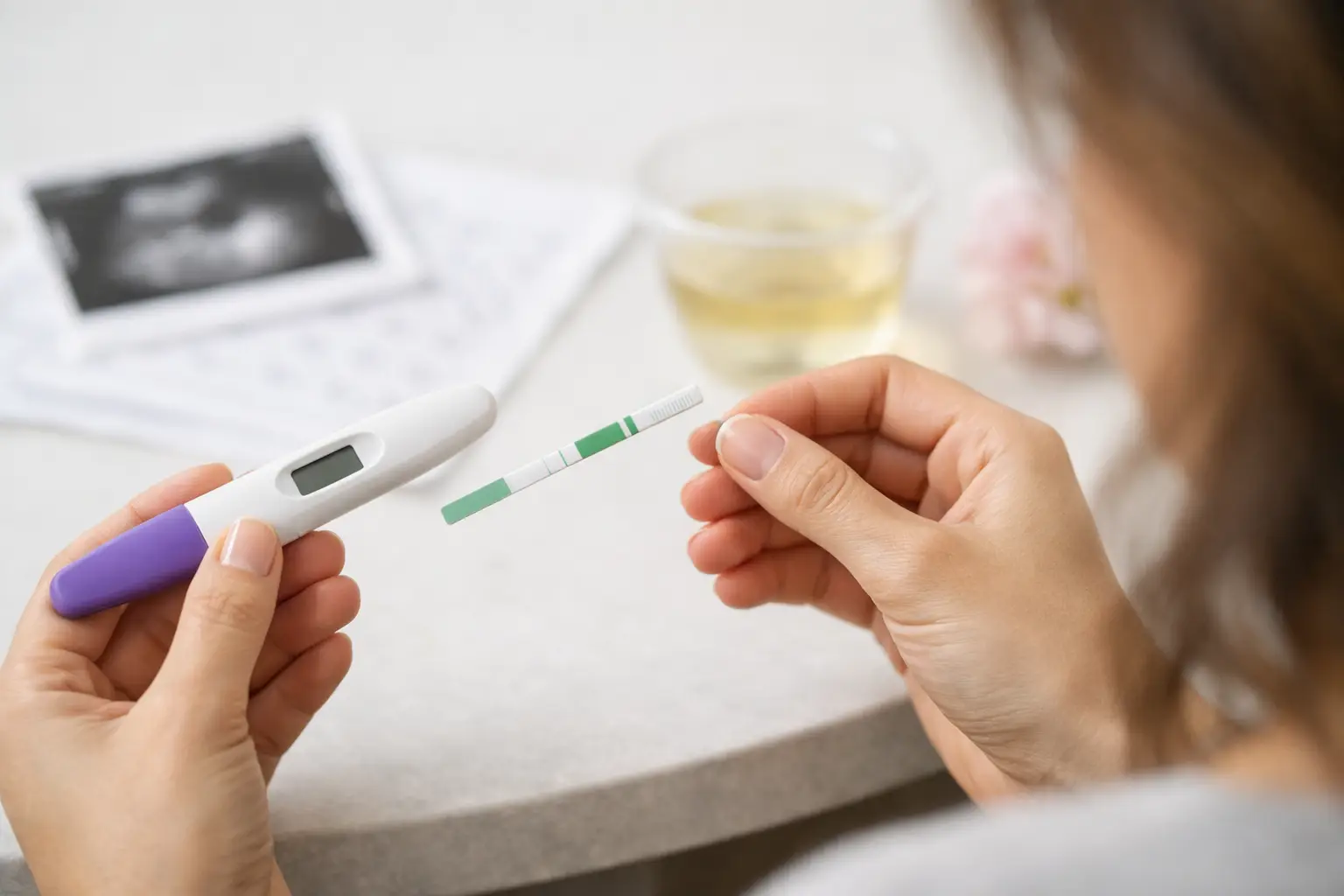
An ovulation test can turn a vague question, "Is this the right time?", into a useful piece of information. Knowing how to use an ovulation test is not about becoming hypervigilant or getting every day exactly right. It is about understanding what the test can tell you, what it cannot, and having a dated record you can use in a conversation with your clinician if you need to.
Ovulation tests are most often used when trying to conceive, but some people also use them to learn more about a changing or unpredictable cycle. Either reason is valid. Paying attention to your body is not fussing, and missing a test does not mean you have failed the month.
What an ovulation test actually measures
Most home ovulation tests detect luteinising hormone, usually called LH, in urine. LH rises shortly before an egg is released from an ovary. This is known as an LH surge.
A positive result suggests that ovulation may happen soon, often within the next day or two. It does not confirm that ovulation has happened, nor can it confirm that pregnancy will occur. The NHS notes that fertility depends on several factors, including the timing of sex, age, sperm health and whether ovulation is taking place regularly. Your cervical mucus may also change around this time; if you want to read that sign as well, we have a separate guide to what ovulation discharge looks like.
That distinction matters. A test is a timing aid, not a verdict on your fertility or your body. A negative result can simply mean that the surge has not started, that it was missed between tests, or that the test was not used at the most suitable time for your cycle.
How to use an ovulation test step by step
First, check the instructions in the box. Different brands have different rules for when to test, how long to hold the test in urine, and how to read a faint line. Follow the instructions for your specific test rather than relying on a rule seen online.
Start by estimating when you might ovulate. In a regular cycle, ovulation often occurs about 12 to 16 days before the next period begins, rather than always on day 14. If your cycle is usually 28 days, a test kit may advise starting around day 11. If your cycle is longer or shorter, the suggested start day will change.
Use the first day of proper menstrual bleeding as cycle day 1. Spotting before a period does not usually count as day 1. If your cycles vary, use the length of your shortest recent cycle when deciding when to begin testing, as many test manufacturers advise. Starting a little earlier can reduce the chance of missing a brief LH surge, although it may mean using more tests. This is also a moment to think about cost: single digital tests add up quickly if you are testing daily or twice daily, and bulk strip tests bought online are a widely used, perfectly reasonable alternative if the brand-name kits are stretching your budget. What matters is the LH line, not the packaging.
Test at roughly the same time each day. Many standard LH strip tests are best used from late morning to early evening, rather than with first morning urine, because LH may take time to appear in urine after the body releases it. Do not drink large amounts immediately beforehand, as very diluted urine can make the result harder to interpret. Again, the packet instructions take priority, especially for digital tests.
For strip tests, a result is generally positive only when the test line is as dark as or darker than the control line. A pale test line is usually negative. With a digital test, follow the symbol shown by that device. Read the result within the stated time window. Looking much later can create evaporation lines, which are not a reliable result.
When you get a positive result, sex on that day and over the following day or two may help cover the fertile window if pregnancy is your aim. There is no need to make this a narrow, high-pressure task. The NHS advises having sex every two to three days throughout the cycle when trying for a baby, which can be a less stressful approach and avoids needing to pinpoint one exact day.
When should you start testing if your periods are irregular?
Irregular cycles make ovulation tests more labour-intensive, not useless. You may need a longer run of tests because there is less certainty about when the LH surge will occur. Some people test once daily at first, then twice daily when the line begins to darken, if their kit permits it.
Keep the basic record simple: note the first day of each period, the days you tested, and whether the result was negative, rising or positive. You can also record cervical mucus if you notice it. Clear, slippery mucus can occur around the fertile window, but it is not a requirement to check and not everyone sees an obvious change.
The useful floor is a period start date and any positive test. More detailed recording is welcome if it helps you notice patterns or prepare for an appointment. What rarely pays back is repeatedly searching every faint line online, testing far earlier than the kit suggests, or comparing your cycle with a stranger's. Cycles are variable, and a single month is not a diagnosis.
Feminal can hold cycle dates, symptoms and other health information in one dated record that is shared live with your linked clinician. The purpose is clearer communication, without relying on memory during a short appointment, not a log kept for its own sake.
Why a positive test does not always mean ovulation
An LH surge usually comes before ovulation, but a urine test cannot prove that an egg was released. Some people can have more than one LH rise in a cycle, and certain health circumstances can make results harder to interpret.
Polycystic ovary syndrome, known as PCOS, may be associated with higher or fluctuating LH levels, which can produce repeated positive or unclear results. Recent pregnancy, the perimenopause, and some medicines used in fertility treatment may also affect testing. So can the months after stopping hormonal contraception, or while breastfeeding: it can take some cycles for LH patterns to settle after coming off the pill, an implant, an injection or a hormonal coil, and confusing or absent results in that window are common rather than a sign that something is wrong. The HFEA advises that home ovulation tests may be less reliable for people with PCOS and that those using fertility medicines should ask their fertility team which method of timing is appropriate.
If you are following an IVF protocol, use the instructions set by your care team. Do not add ovulation testing or change the timing of medication based on a home result unless they have specifically advised it.
When to speak to a clinician
A few negative tests in one cycle are common and do not, by themselves, mean there is a problem. It can be reasonable to speak with a GP, gynaecologist or fertility clinician if your periods are very irregular or absent, if you repeatedly never identify a positive result, or if the testing process is becoming distressing.
The NHS advises seeking fertility advice after one year of regular unprotected sex without pregnancy if you are under 36, and sooner if you are 36 or over or have a reason to be concerned about fertility. Reasons to seek advice earlier can include previous pelvic infection, endometriosis, known problems affecting the uterus or ovaries, previous cancer treatment, or concerns about sperm health.
Seek urgent medical care for severe or worsening pelvic pain, heavy bleeding, fainting, shoulder-tip pain alongside abdominal pain, or a positive pregnancy test with pain or bleeding. An ovulation test cannot explain these symptoms.
A home test is most useful when it gives you a clearer next question, not when it asks you to carry the whole burden of certainty. Record what you see, take your concerns seriously, and let a clinician help interpret the pattern when the pattern needs more than a strip can provide.
Sources used
NHS guidance on trying for a baby and fertility. HFEA information on ovulation tests and fertility treatment. NICE guidance on fertility problems and assessment.