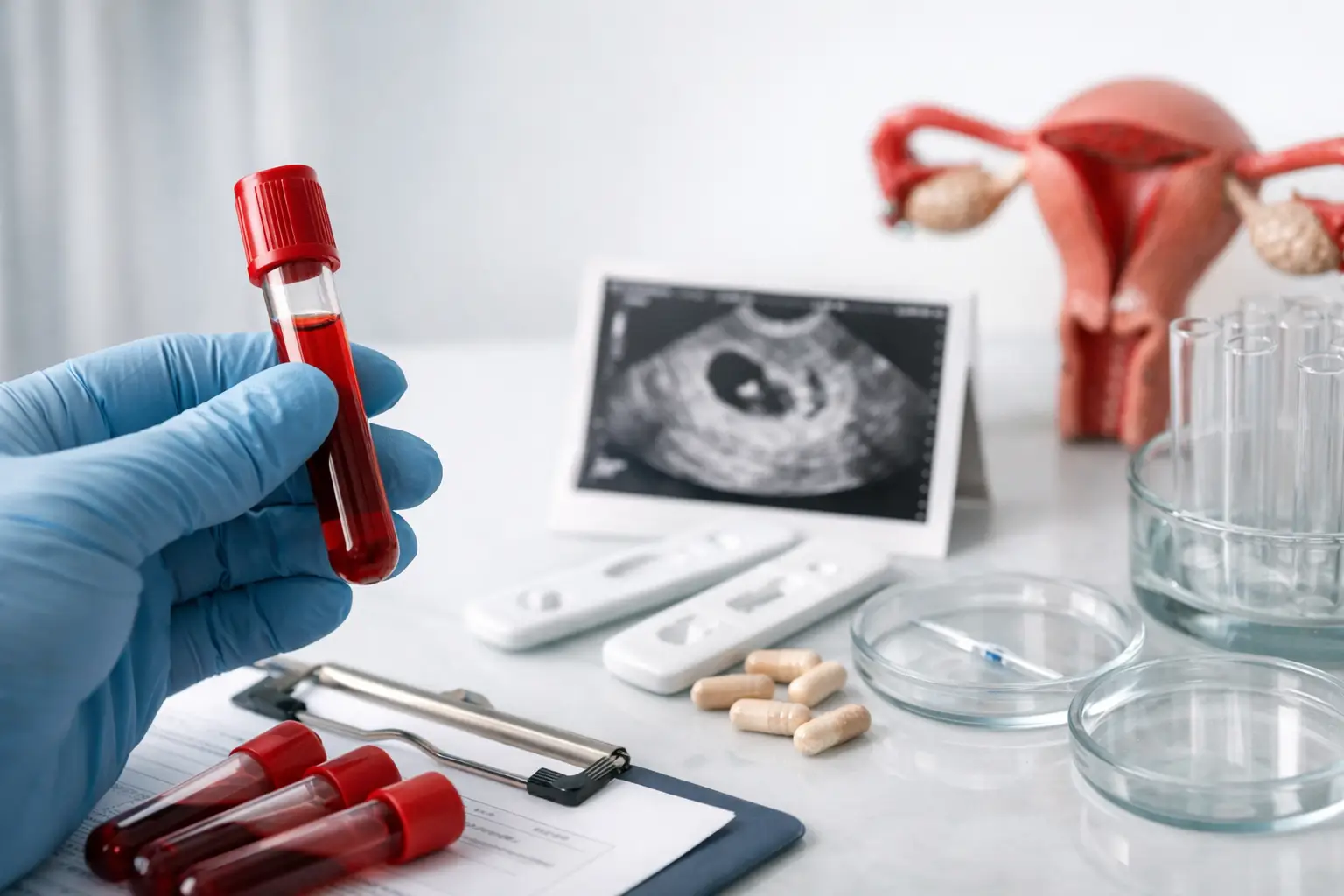
A blood test result can look definitive on a screen: a number, a reference range, perhaps a flag beside it. Fertility blood tests are useful, but they are not a verdict on whether you will become pregnant, how quickly, or whether you have done something wrong. They are one part of a wider assessment, interpreted alongside your age, menstrual pattern, medical history, partner factors and, sometimes, scans or semen analysis.
If you have been trying to conceive, have irregular or absent periods, or are preparing for fertility treatment, asking what each test is for is reasonable. Paying attention to your cycle is not fussing. A dated record can make an appointment more precise, particularly when a hormone result needs to be matched to a particular point in your cycle.
What fertility blood tests are trying to answer
A clinician may use blood tests to explore several different questions. Are you likely to be ovulating? Are there signs that thyroid function or raised prolactin could be affecting your periods? Is there information that may help plan fertility treatment? Are symptoms such as acne, increased facial hair, irregular bleeding or missed periods part of a wider hormone pattern?
The answer is rarely contained in one test. NICE recommends that fertility assessment considers both partners where relevant, and includes a history of how long you have been trying, menstrual regularity, previous pregnancies, medical conditions, medicines and sexual history. This matters because fertility is not solely an ovarian question. Sperm factors, blocked fallopian tubes, endometriosis and conditions affecting the uterus cannot be ruled in or out by a hormone panel alone.
Tests related to ovulation
Progesterone is often measured to check whether ovulation is likely to have occurred. The timing matters more than the familiar phrase "day 21 test". For someone with a 28-day cycle, day 21 may fall roughly seven days before the next period. With longer, shorter or irregular cycles, testing on day 21 may simply be too early or too late.
NICE advises measuring mid-luteal progesterone about seven days before the expected period in women with regular cycles. If cycles are irregular, repeat testing or a different approach may be needed. A single progesterone result is a snapshot, not a moral report card on your body.
Tests related to ovarian reserve
Anti-Müllerian hormone, usually called AMH, is commonly discussed as an "egg reserve" test. It can provide information about the number of eggs remaining in the ovaries relative to others of a similar age and can help clinicians anticipate how the ovaries may respond to medicines used in IVF.
That is useful information in the right setting. It does not measure egg quality, prove whether you are ovulating, predict natural conception accurately, or set a deadline on pregnancy. The HFEA cautions that ovarian reserve tests do not tell a woman's chance of getting pregnant naturally. AMH should be interpreted carefully, especially if a result arrives before you have had a chance to discuss what it does and does not mean with a clinician.
This caution matters most where AMH is increasingly sold: as a standalone test bought online or at a pharmacy, delivered as a number with no clinician attached to explain it. A low or unexpected result arriving this way, with no context and no one to ask, can cause real distress that the number itself does not justify. If you are curious about your ovarian reserve, the more useful route is asking a GP or fertility clinician to arrange the test as part of a proper assessment, so the result comes with someone qualified to interpret it alongside your history, not as a countdown delivered to your inbox.
Follicle-stimulating hormone, or FSH, and oestradiol may also be tested early in the menstrual cycle, often between days 2 and 5. Their interpretation depends on the day of testing and the laboratory method. They are not interchangeable with AMH, and a normal result cannot exclude every fertility difficulty.
Tests for other hormone patterns
Thyroid-stimulating hormone, known as TSH, may be checked because thyroid conditions can affect periods and ovulation. Prolactin may be tested where there are irregular periods, absent periods or symptoms such as unexpected milk production. Depending on your history and symptoms, a clinician may also request testosterone or other androgen tests when polycystic ovary syndrome, or another cause of androgen excess, is being considered.
These tests can point towards questions worth investigating. They do not, on their own, establish a cause. Results need context: hormonal contraception, some medicines, recent pregnancy, breastfeeding, illness, weight changes and stress can all affect menstrual cycles or laboratory values.
When should testing happen?
Some tests can be taken at almost any point in the cycle. Others are only meaningful when timed properly. Before a blood draw, ask which day of your cycle the test should happen, whether you need to fast, and whether any prescribed medicines or supplements could affect the result. Do not stop prescribed medication without advice from the clinician who prescribed it.
The first day of a proper period is usually counted as cycle day 1. Light spotting before bleeding properly starts may not count, but practices can differ. If you are unsure, record what happened and ask. It is better to bring a slightly imperfect record than to rely on a reconstructed memory under pressure.
A simple floor is enough: note the first day of each period, whether your cycles are broadly regular, and the dates of blood tests and relevant medication changes. If you want to record more, such as spotting, pelvic pain, cervical mucus, headaches or changes in acne, that is valid too. More detail is useful when it answers a question you and your clinician are already exploring. It is less useful when it becomes hourly checking, repeated early testing, or comparing your cycle with strangers online.
Feminal can bring cycle dates, symptoms, medications, supplements and vitals into one dated record that is visible live to a linked clinician. It cannot interpret a result for you, but it can make the timing and context of a result easier to discuss.
What a result cannot tell you
The most difficult part of fertility testing is often living with uncertainty. A "normal" hormone panel does not guarantee conception, and an unexpected result does not mean pregnancy is impossible. Laboratory reference ranges are not personal fertility scores.
Blood tests cannot assess whether fallopian tubes are open. They cannot reliably identify endometriosis, assess sperm quality, or show every issue with the uterus. Depending on the situation, a clinician may discuss ultrasound, tests of tubal patency, semen analysis, or referral to a fertility service. The NHS advises seeking medical advice after a year of regular unprotected sex without pregnancy, or sooner if you are aged 36 or over, have irregular or absent periods, have had pelvic inflammatory disease or ectopic pregnancy, or have another reason for concern.
If a result is outside the reference range, ask three practical questions: what was this test intended to assess, could the timing or medication have affected it, and what would the next step be if it is repeated or confirmed? You are allowed to ask for the actual number, the laboratory range and a copy of your results. This is not challenging your clinician. It is participating in your care.
Preparing for the appointment
Bring the information that changes interpretation: the date of your last period, your usual cycle length, how long you have been trying to conceive, previous pregnancies or miscarriages, contraception history, current medication and supplements, and any relevant symptoms. If conception involves a partner, it can be helpful to ask early whether assessment should happen in parallel rather than placing every question on one person's body.
Try not to treat a blood test as a test of effort. You do not need a perfectly charted cycle to deserve care, and you have not failed if you missed a date or do not know exactly when you ovulated. The point is not to produce flawless data. It is to give your clinician enough context to decide what, if anything, should be explored next.
If you have severe one-sided lower abdominal pain, shoulder-tip pain, fainting, or bleeding and there is any possibility of pregnancy, seek urgent medical care straight away. These can be symptoms of ectopic pregnancy and should not wait for a routine fertility appointment.
A result can be useful without being the whole story. Let it become a better question for your clinician, not a reason to distrust what you have noticed in your own body.
Sources used
NICE guideline on fertility problems: assessment and treatment. HFEA information on ovarian reserve testing and AMH. NHS guidance on fertility tests and when to seek advice.