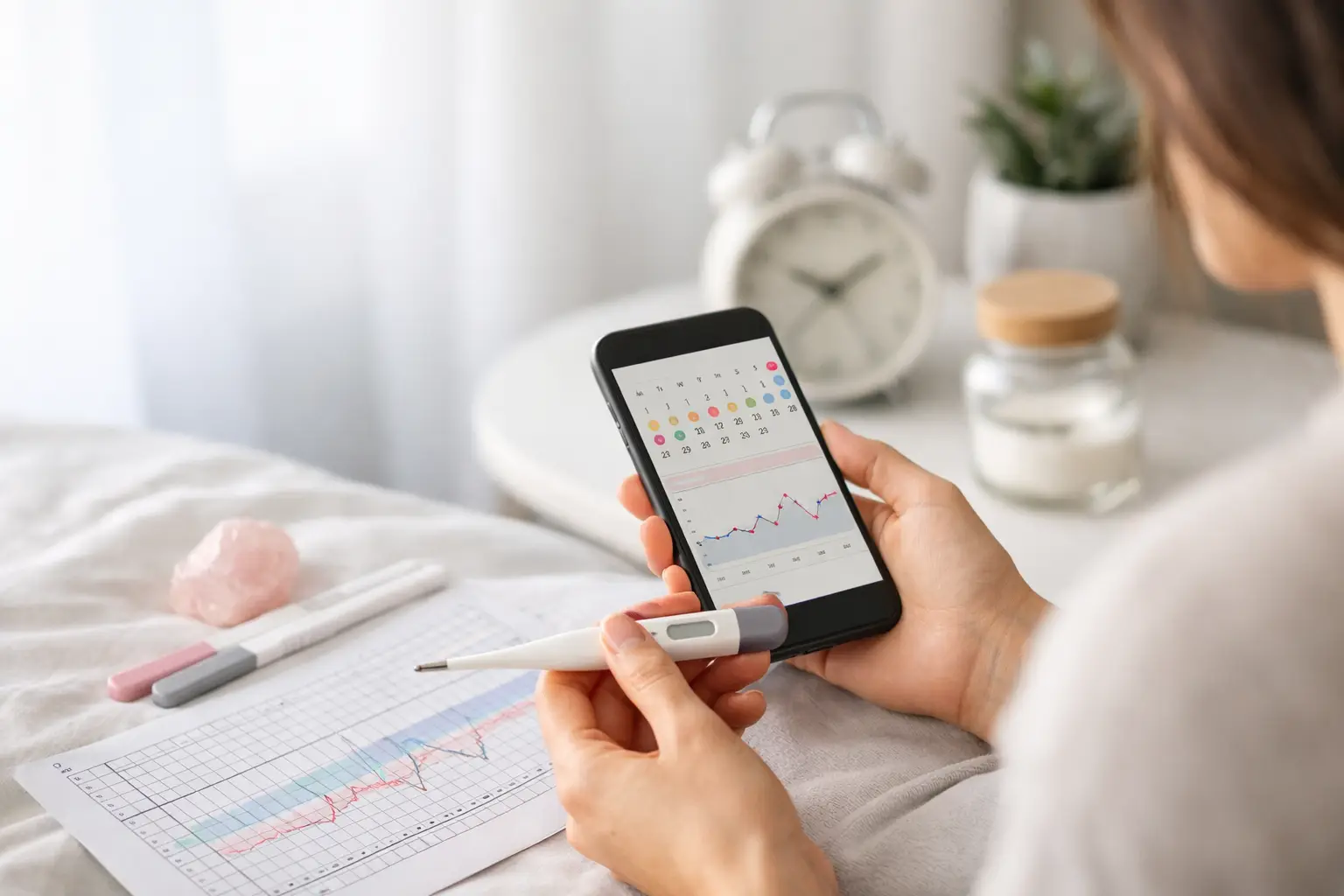
A late period, a change in discharge, a temperature that looks different from last month: fertility awareness methods can give these observations useful context. They are not a test of whether you are attentive enough, nor a way to make your body perfectly predictable. Used carefully, they are a structured way to notice cycle patterns, whether you are trying to conceive, avoiding pregnancy, or preparing for a conversation with a clinician.
The useful question is not whether you can track every detail. It is what information would help you make a decision, ask a clearer question, or recognise when your usual pattern has changed.
What are fertility awareness methods?
Fertility awareness methods, sometimes called natural family planning, use signs from the menstrual cycle to estimate when pregnancy is more or less likely. The central aim is to identify the fertile window: the days before ovulation and the day of ovulation when sex without contraception may lead to pregnancy.
This window exists because sperm can survive in the reproductive tract for several days, while an egg is viable for a much shorter time after ovulation. Ovulation does not always happen on day 14. For many people, it occurs roughly 12 to 16 days before the next period, which means the timing can shift when cycle length shifts. The NHS advises that natural family planning requires learning the method properly and recording observations every day, and it is best learned from a trained fertility awareness instructor rather than pieced together alone; your GP or sexual health service can refer you to one.
The main fertility signs are menstrual dates, cervical mucus and basal body temperature. A symptothermal method combines more than one sign. Some people also use urine ovulation tests, which detect the rise in luteinising hormone that often happens before ovulation. These can add information, but a positive test does not guarantee that ovulation has occurred.
Fertility awareness is not the same as an app prediction based only on previous period dates. Calendar estimates can be a starting point, but past cycle length cannot reliably tell you what your ovaries will do this month.
The signs, and what they can realistically show
Cervical mucus can signal approaching fertility
Cervical mucus often becomes wetter, clearer, slippery and more stretchy as oestrogen rises before ovulation. Some people describe it as similar to raw egg white. These changes can indicate that fertile days may be approaching; our guide to what ovulation discharge looks like covers this sign in more depth.
Discharge can also change because of sex, lubricants, vaginal infections, medication, breastfeeding or normal variation. It is worth noticing changes without assuming that every change has one meaning. New discharge with a strong smell, itching, soreness, pelvic pain or bleeding after sex deserves clinical advice rather than interpretation through a fertility chart.
Basal body temperature confirms a change after it happens
Basal body temperature is your resting temperature, taken immediately on waking and before getting up, ideally at a similar time each day. After ovulation, progesterone usually causes a small, sustained rise in temperature. A series of higher readings can therefore support the view that ovulation has already happened.
That timing matters. Temperature is generally better at confirming a pattern retrospectively than predicting the fertile window ahead of time. Poor sleep, alcohol, illness, shift work, travel and a different measuring routine can all affect a reading. One unusual temperature is information, not a verdict.
Cycle dates give context, not certainty
Recording the first day of full menstrual bleeding makes it easier to see cycle length and variation over time. It can be especially useful at appointments, where it is difficult to reconstruct several months from memory.
But a regular-looking cycle does not confirm ovulation, and an irregular cycle does not mean pregnancy is impossible. Conditions such as polycystic ovary syndrome, thyroid disorders and elevated prolactin can affect ovulation, but only an appropriate clinical assessment can investigate why a pattern is changing.
If you are using fertility awareness to avoid pregnancy
This is where precision matters most. Fertility awareness methods can be an effective form of contraception when taught and used correctly, but they require daily attention, clear rules and a plan for days that may be fertile. They do not protect against sexually transmitted infections, so condoms remain important when there is any risk of infection.
The NHS states that fertility awareness methods are between 91% and 99% effective at preventing pregnancy when the instructions are followed correctly and consistently. If they are not followed exactly, effectiveness falls to around 76%. That gap is the method in a nutshell: the ceiling is genuinely high, but it depends on training and daily discipline rather than the method being inherently unreliable. A method based only on an app's predicted ovulation date is less dependable than a taught method that uses observed fertility signs.
This approach may be less straightforward if you have irregular cycles, have recently stopped hormonal contraception, are in the perimenopause, work changing shifts, or find daily measurements difficult to sustain. That is not a personal failure. It may simply mean another contraceptive method offers more reassurance for your circumstances. A GP, sexual health service or clinician trained in fertility awareness can discuss options without treating your preferences as frivolous.
If you have recently given birth and are breastfeeding, the lactational amenorrhoea method, or LAM, is a specific, named approach worth asking about rather than an informal assumption that breastfeeding alone offers protection. It works within strict conditions: exclusive or near-exclusive breastfeeding, no periods having returned yet, and generally within the first six months after birth. Met properly, the NHS describes it as highly effective; outside those conditions, it is not reliable, so it is worth confirming with a midwife or GP whether you meet them.
If you are trying to conceive
Fertility awareness can help you recognise when sex is most likely to result in pregnancy, but it cannot make conception controllable. The NHS advises having sex every two to three days throughout the cycle when trying for a baby. For some couples, this is less pressured than trying to identify one perfect day.
If you prefer to time sex more closely, cervical mucus observations and ovulation tests may help identify the days before ovulation. A temperature rise can be useful for understanding whether a cycle appears to have included ovulation, but it comes too late to guide timing in that same cycle.
Do not turn a chart into a monthly judgement. A well-recorded cycle can still end without pregnancy, and missing a temperature because you slept badly does not undo the information you have. Attention should be aimed, not rationed, but it should also pay you back. Repeated early pregnancy testing, searching every symptom online and comparing your chart with strangers' cycles usually create more anxiety than clarity.
NICE recommends fertility assessment after one year of regular unprotected sex without pregnancy. Earlier discussion is appropriate if the person trying to conceive is aged 36 or over, has known fertility concerns, very irregular or absent periods, a history of pelvic inflammatory disease or ectopic pregnancy, previous cancer treatment, or there are concerns about semen parameters. The HFEA also stresses that fertility difficulties can affect either or both partners, so assessment should not rest automatically on one person.
A record that helps at an appointment
A simple floor is enough to begin: record the first day of bleeding, cycle length, any ovulation test result you choose to use, and notable symptoms or changes. Over a few cycles, dates become more useful than a general impression that things have been odd lately.
If you want more detail, add morning temperature, cervical mucus descriptions, bleeding pattern, medications, supplements, sleep disruption and relevant illness. You are not obsessive for recording this. A dated, specific record can be a form of advocacy, particularly when symptoms are intermittent or an appointment is brief.
Feminal allows patients to record cycle information, symptoms, medications, supplements and vitals, with that record visible live to a linked clinician. The record exists to carry the details between appointments, not to keep watch over you between them, so you are not required to remember everything under pressure.
Bring the pattern, not only the data. For example: my cycles changed from 29 to 45 days over four months; I have not seen a sustained temperature rise; or I am bleeding between periods and have pelvic pain. These statements help a clinician understand what has changed and decide what, if anything, needs investigating. Fertility awareness observations can inform care, but they cannot diagnose a cause.
When not to wait for a chart to explain it
Seek urgent medical care if you may be pregnant and have severe or one-sided lower abdominal pain, shoulder-tip pain, dizziness, fainting, or bleeding. These can be symptoms of an ectopic pregnancy and need prompt assessment. Seek medical advice for very heavy bleeding, new severe pelvic pain, or symptoms that are escalating or making daily life difficult.
For everything else, your observations are allowed to be useful even when they are incomplete. Bodies are not machines, and fertility awareness methods work best as informed observation rather than a demand for certainty. Notice what is happening, record the part that helps, and let a clinician help with the questions a chart cannot answer.
Sources used
NHS guidance on natural family planning and trying for a baby; NICE guideline on fertility problems: assessment and treatment; HFEA information on fertility and treatment.